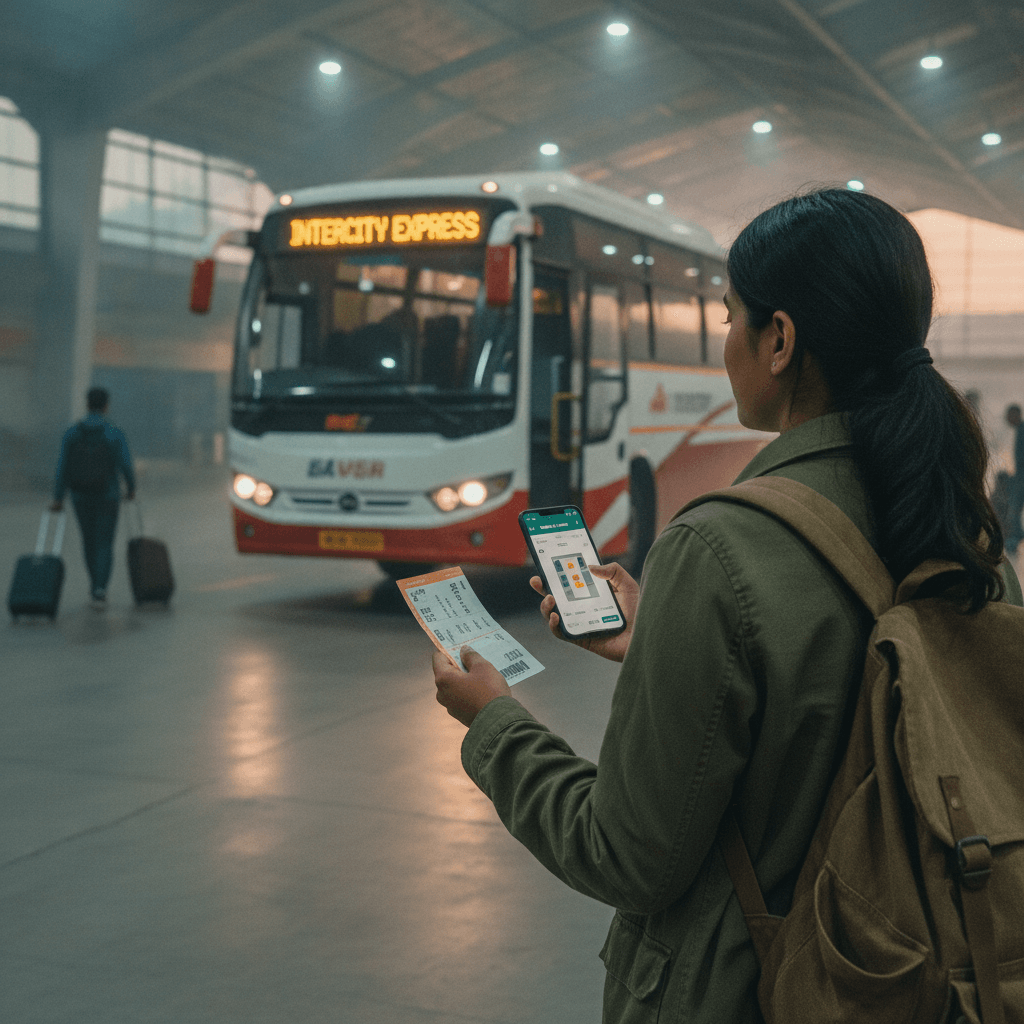

Here's the short answer. Search your route online, filter by departure time and bus type, check recent ratings for the operator, pick your seat on the layout map, and confirm your boarding point before you pay. Do that a few days ahead for normal weekdays, and a week or more ahead for weekends and festivals. Most people only get the first step right. If you want to compare everything in one place, start your bus booking there and work through the rest of this guide as you go.
I've done a lot of overnight buses between big Indian cities. Bangalore to Chennai, Mumbai to Pune, Delhi to Jaipur, Hyderabad to Bangalore. The booking itself takes five minutes. The mistakes that ruin the trip usually happen in those five minutes too. So let's go through what actually matters.
Start with the route, not the operator
On busy corridors, dozens of operators run the same stretch every night, so you don't need to go hunting for a specific company. Search the city pair and let the options come to you. A quick look at popular bus routes also helps you see how crowded a corridor gets and what kinds of buses run on it.
Now the useful part. On high-demand routes like Mumbai to Goa or Bangalore to Hyderabad, you get a wide range of fares and bus types for the same journey. A basic non-AC seater and a premium multi-axle sleeper can be leaving from nearly the same spot within 20 minutes of each other, and one might cost three times the other. Neither is wrong. It depends on whether you're trying to save money or trying to sleep.
A tip people overlook is to check one day either side of your planned date. Friday night and Sunday evening departures cost more and sell out faster on almost every popular intercity route. If you can leave Thursday night or come back Monday morning, you'll often save a decent amount and get a better seat as well.
Comparing operators without losing your mind
This is where most people either overthink it or don't think at all. You'll see a long list of operators, and they can look almost identical. Here's what I actually check, in this order:
- Recent ratings, not just the overall score. An operator with a 4.3 average built over years can still have had a bad few months. Scroll the latest reviews and look for patterns like late departures, AC not working, or rude staff.
- Bus type. "AC Sleeper (2+1)" and "AC Seater/Sleeper (2+2)" are very different experiences on a 9-hour overnight ride.
- Journey duration. If one bus takes 8 hours and another takes 11 on the same route, the slower one probably makes more stops or takes a longer road.
- Cancellation policy. It varies a lot between operators, and you won't care until your plans change.
Honestly, I'll pay a bit more for an operator whose recent reviews say "left on time" over and over. Punctuality is the thing you can't fix once you're on the road.
Also, don't be too impressed by fancy bus names. "Luxury" and "Premium" in the title don't promise anything. The bus type and the reviews tell you far more.
When to book and which departure to pick
For a regular weekday trip on a busy route, booking two to four days ahead is usually fine. You'll have options. For weekends, book about a week out. For Diwali, Pongal, Christmas, long weekends, or anything near school holidays, book as early as you can, ideally two to three weeks ahead. Fares on some routes rise sharply as seats fill, and the good sleeper berths go first.
Departure time matters more than people think, especially overnight. If the journey is 8 to 9 hours, a 10 or 11 PM departure gets you in around 7 AM, which is ideal. Leave at 8 PM and you might arrive at 4:30 AM in a city where nothing is open and your hotel check-in is hours away. I've done that. Sitting in a bus depot with your backpack at 5 AM is not fun.
If an early arrival can't be avoided, it's worth sorting out where you'll go first. Some hotels allow early check-in if you ask ahead or pay a small fee, which is much better than wandering around half asleep.
Picking the right seat (and the boarding point everyone forgets)
Once you've chosen a bus, you'll see a seat layout. A few rules I follow:
On a 2+1 sleeper, the single berths on one side are the best choice if you're travelling alone, because you get privacy and nobody climbs over you. Lower berths are easier to get in and out of, and upper berths are a bit more private but bounce around more. Avoid the very back row. It's bumpier, it's usually near the washroom if there is one, and on some buses it sits right over the engine. For women travelling solo, many platforms show seats reserved for or booked by women, which is genuinely helpful when you're choosing who you'll be lying next to on a 2+2 layout.
Now the boarding point. This is the step that catches people out more than anything else. Big cities have many pickup points along the route, and the bus might reach your stop 45 minutes after its listed departure from the first point. Or it might be earlier. Read the exact address and landmark, and check the time listed for your stop, not the origin. Save the operator's contact number, because you'll usually get it after booking, and you'll want it if the bus is running late.
If your boarding point is across town, don't plan on catching an auto at the last minute during peak traffic. Booking one of the cabs ahead of time to get there is a small cost that saves a lot of stress. A missed bus is rarely refundable.
When the bus isn't actually the right call
I love overnight buses because you save a night's hotel and wake up at your destination. But they're not always the best choice, and I'd be lying if I said otherwise.
If the journey is more than 12 to 14 hours, think hard about it. Delhi to Manali is popular by bus and it's fine. Something like Bangalore to Delhi by road would be silly when flights on that route can cost about the same as a premium sleeper once you book early enough. A useful test: if the bus fare plus the day you lose is worth more than a cheap flight, fly.
Monsoon season is the other thing to think about. Ghat routes like Mumbai to Goa or anything through the Western Ghats can run late, sometimes by several hours, when the rain is heavy. Build in some slack, and don't book a tight onward connection.
And if you're arriving somewhere new and want something nicer than a standard hotel, like a homestay near the hills or a villa for a group, it's worth browsing stays at your destination. Buses work really well for that kind of trip. You arrive early, drop your bags, and you've got the whole day.
A quick checklist before you hit pay
Look, none of this is complicated. It's just easy to rush. Before you confirm, I run through this:
- Is the date right? Overnight buses that leave at 12:15 AM are listed under the next day, and people book the wrong date all the time.
- Is the boarding point right, and do I know the exact time for my stop?
- Is the drop point actually where I want to end up, and not some highway stop 20 km outside the city?
- Have I read the cancellation terms?
- Are the passenger names and contact number correct? Some operators check ID against the ticket.
For longer trips or anything during monsoon, I also think about travel insurance. It's not something you need every time, but it's worth it if you've prepaid hotels at the other end that you'd lose if the trip falls apart.
That's really it. Choose the route, compare honestly, pick a sensible departure time, take care over your seat and boarding point, and double-check before you pay. When you're ready, head over and book your intercity bus in a few minutes. If you'd rather not juggle transport and accommodation separately, holiday packages can bundle the whole thing so all you have to do is show up at the boarding point on time.