





Let's talk about the Jerash ruins in Jordan.
If you're planning a trip to the Middle East, you probably have Petra circled in bright red marker. Everyone does. But I'm going to tell you a little secret. A lot of travelers actually end up enjoying Jerash just as much. Why? Well, for starters, you can actually walk on the old Roman streets. There are no velvet ropes keeping you away. You can touch the massive columns. You can sit in the amphitheater where thousands of people sat two millennia ago. It feels real and gritty, not overly manicured.
Let's get the logistics out of the way first.
Getting here is super easy. The ancient Roman city of Jerash is located just about 48 kilometers north of Amman. If you rent a car, the drive takes maybe 45 minutes on Route 35. The roads are modern and well-paved. Don't want to drive? No problem.
Let's touch on how to get to Jerash from Amman without your own wheels.
You can take a yellow taxi from the capital, which will run you about 40 JOD (Jordanian Dinars) for a round trip where the driver waits for you. Or, if you're on a tight budget, head to the North Bus Station in Amman (Tabarbour) and catch a public minibus. That costs less than 2 JOD each way. It's a bit chaotic, and they only leave when every seat is full, but it gets the job done. If you want maximum comfort, your hotel in Amman can easily arrange a private driver for the day for around 50 to 70 JOD.
When you arrive, your first stop is going to be the Jerash Visitor Center.
It's a fairly modern building where you buy your tickets and pick up a map. If you bought the Jordan Pass before your trip (and you definitely should; it saves you so much money), your entrance is already covered. Just show them the QR code on your phone. If you don't have the pass, the standard Jerash entrance fee is 10 JOD. Honestly, that's a steal for what you're about to experience.
Once you get your ticket, you walk through a little outdoor market area. Vendors will try to sell you t-shirts, sand art, and cheap jewelry. They aren't super aggressive, but a simple "no thank you" works fine. Then, you turn a corner and boom. Hadrian's Arch is staring right at you. It was built in 129 AD to welcome the Emperor Hadrian. It's massive. And this is just the warm-up.
Right after the arch, you'll walk past the Hippodrome. This was a giant sporting arena. Back in the day, they held chariot races here for up to 15,000 spectators. Up until a few years ago, they actually put on mock chariot races for tourists, but they stopped doing that. Still, walking down the center of the sandy track, you can almost hear the horses.
Next up is the South Gate, which leads you into the actual walled city.
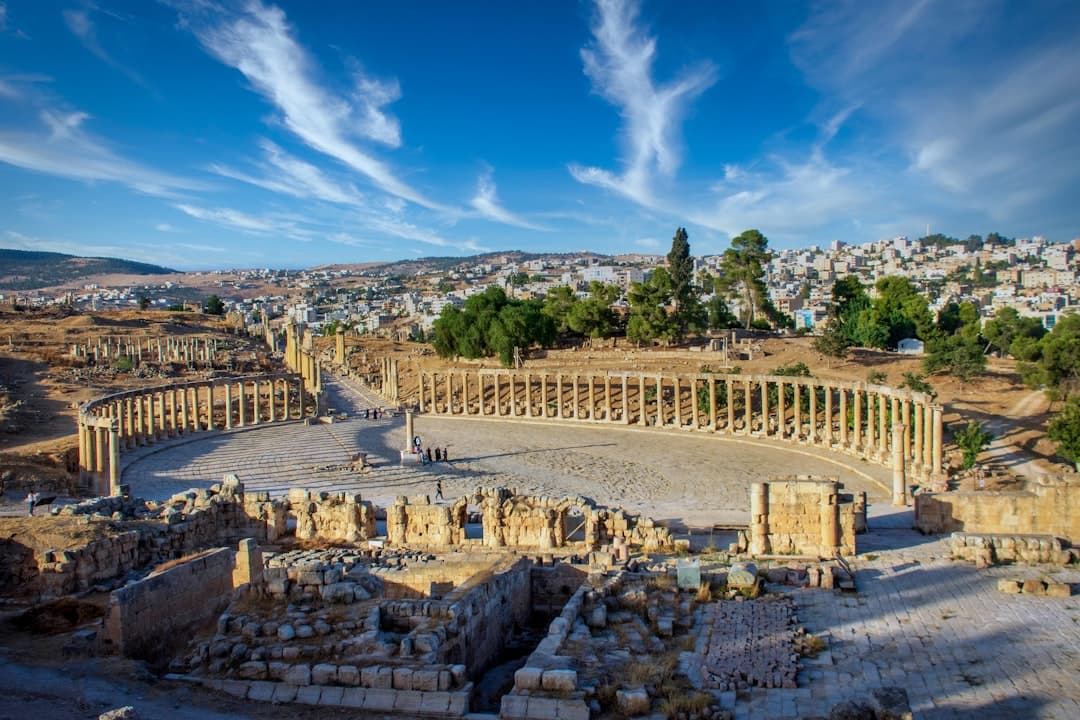
And this is where things get crazy. You step out onto the Oval Plaza. It's a massive, asymmetrical public square completely surrounded by towering stone columns. I guarantee you'll stand there for a minute just trying to take it all in. The floor is made of huge, original limestone paving stones. (Watch your step, by the way. The rocks are super uneven and can get slippery if it rains.)
From the plaza, you walk straight onto the Cardo Maximus. This was the main street of the city. It's about 800 meters long, and it still has the original ruts cut into the stones by thousands of Roman chariot wheels. It's wild to think about. You can literally walk in the exact tracks of a chariot from 2,000 years ago.
As you walk down the Cardo, look at the columns. Some are completely smooth, while others have intricate carvings. Look closely at the ground, too. You'll spot old manhole covers. Yes, the Romans had a fully functional underground sewage system here. Pretty advanced for the first century.
Let's talk about the weather for a second.
If you're looking up the Jerash weather, you need to know that summer gets hot. Really hot. We're talking 35°C to 40°C in July and August. And there is almost zero shade out there in the ruins. If you go in the summer, get there at 8:00 AM, right when the gates open. Bring at least two liters of water per person. Sunscreen and a hat are completely mandatory.
If you go in November or March, it's totally different. You might even need a light jacket.
About halfway down the main street, you'll see a massive staircase on your left leading up to the Temple of Artemis.
She was the patron goddess of the city. Climb the steps. It's a bit of a workout, but the view from the top is absolutely killer. The columns up here are ridiculous. They're so tall, and some of them actually sway a tiny bit in strong winds. (Local guides love to show you this by sticking a spoon under the base of a column so you can see it move. It's a neat trick.)
Speaking of guides, you don't have to hire one. You can easily wander around the Jerash archaeological site by yourself. But if you want to know what you're actually looking at, there are official guides waiting near the South Gate. They charge about 20 to 30 JOD for a two-hour tour. Totally worth it if you love history.
There are two massive theaters in the city.
The South Theater is the bigger one. It used to seat about 3,000 people. Climb up to the top rows. The acoustics are insane. You can stand in the exact center of the stage, drop a coin, and someone sitting in the very top row will hear it hit the stone.
Often, you'll find local guys in traditional military uniforms playing bagpipes in the theater. It sounds completely out of place, but it's a cool nod to the British military history in the region.
We shouldn't skip the North Theater, either. It's a bit smaller, originally built to hold about 1,600 people for government meetings and intimate performances.
You'll also notice a bunch of Byzantine church ruins scattered around the hills above the main street.
When the Roman Empire shifted to Christianity, they repurposed a lot of the old pagan temples. You can still see some amazing mosaic floors if you look closely.
Standing up by those churches gives you a fantastic view of the modern town of Jerash, Jordan, right across the valley. It creates this wild contrast. You have 2,000-year-old crumbling pillars in the foreground, and then modern houses, satellite dishes, and traffic in the background.
A lot of people ask, "Is Jerash safe for tourists?"
The answer is a massive yes. Jordan in general is incredibly safe, and this town is totally geared toward tourism. You'll see families, solo backpackers, and older couples everywhere. Crime against tourists is extremely rare.
When you finish your walk through the ancient stones, you'll probably be starving.
You have a few options for food. There's a decent restaurant right at the visitor center that serves standard buffet food. It's fine. But if you want something really good, walk into the modern town. Go to the Lebanese House. It's a famous local spot. The hummus and grilled meats there will fix you right up after a long morning of walking.
Anyway, figuring out things to see in Jerash isn't hard, because the whole place is basically one giant open-air museum.
You just wander. You get lost among the stones. You take way too many photos of columns. You really shouldn't skip this place.
The scale of the Roman ruins in Jordan is hard to comprehend until you're standing in the middle of them. It's often called the "Pompeii of the East" because it was buried under sand for centuries, which is why it's preserved so well.
So, if you were sitting on the fence about whether or not to add this to your travel plans, consider this your push. Put on some comfortable sneakers, grab a water bottle, and go see it for yourself. Your legs might be tired at the end of the day, but you definitely won't regret it.