
If you've never been to Kolkata during Durga Puja, nothing can prepare you for it. It's not just a festival. The entire city transforms into an open-air art gallery. It becomes a massive street food carnival. And it turns into a sleepless, pulsating crowd of millions. It is absolute magic. It is also absolute chaos.
If you're already trying to figure out where to stay in Kolkata for Durga Puja 2026, you're doing it right. People think booking a year or even a year and a half in advance is crazy. But the good places—the ones that don't trap you behind hours of barricaded traffic—vanish fast. Prices double, triple, and sometimes just invent new numbers.
I've navigated this festival more times than I can count. The location of your bed dictates exactly what kind of experience you're going to have. Do you want to walk out of your lobby straight into a sea of people? Or do you need a quiet retreat to recover from the sensory overload? Let's break down the neighborhoods and figure out what actually works.
South Kolkata: Right in the Middle of the Madness
South Kolkata is ground zero for the modern, massive, award-winning pandals. Neighborhoods like Ballygunge, Gariahat, Rashbehari, and Kalighat are where the big-budget magic happens. If you want to see the intricate theme pujas that go viral on social media, this is the area.
Staying here means you are living the festival. You step out of your guesthouse or boutique hotel. You're immediately part of a moving river of pedestrians. You'll hear the dhak (traditional drums) from your bedroom window. You can walk from one major pandal to the next without worrying about transport.
But here's the reality check: you won't get much sleep. The crowds start building up in the late afternoon. They don't dissipate until 4 or 5 in the morning. Loudspeakers play music and announcements constantly. Traffic restrictions are brutal here too. If you book a stay tucked deep inside a residential lane in Ekdalia or Mudiali, Ubers will outright refuse to drop you at your door. You'll be walking a lot with your luggage if you arrive during the core days of the festival.
For stays here, I usually prefer bed and breakfasts or local homestays. There are some lovely older homes converted into boutique properties in Ballygunge. They give you a local, intimate vibe. That feels right for the festival. Just don't expect a lot of five-star amenities in the deep south residential pockets.
Central Kolkata & Park Street: The Strategic Sweet Spot
Central Kolkata is honestly your best bet if it's your first time navigating the city during Puja. When people ask me about the best areas to stay in Kolkata for Durga Puja, I almost always point them toward Park Street, Esplanade, or the Sudder Street area.
Why? Connectivity. Central Kolkata sits right in the middle of the North-South Metro line. During Durga Puja, the roads become parking lots. Taxis refuse to go anywhere near the major pandals. Buses are painfully slow. The underground Metro is your absolute lifeline. From Park Street or Maidan station, you can shoot up to North Kolkata in 20 minutes, or head down south in about the same time.
The accommodation mix here is huge. You've got iconic heritage hotels that offer a brilliant, old-world refuge from the crowds. You've got solid, reliable mid-range business hotels. And there are endless budget options around Sudder Street, though they get cramped during the festival.
Park Street also has the added benefit of food. Pandal hopping makes you violently hungry. Trying to get a table at a decent restaurant in South Kolkata during dinner time is basically the Hunger Games. Park Street's famous restaurants are still packed. But because the density of eateries is so high, you can usually find somewhere good to eat within walking distance of your hotel.
North Kolkata: The Soul of the Old City
North Kolkata is entirely different. Areas like Shovabazar, Bagbazar, and College Street are where the festival retains its oldest traditions. The streets are narrower. The buildings are ancient with slatted green windows. The idols are usually crafted in the traditional 'Ekchala' style, with all deities under one arch.
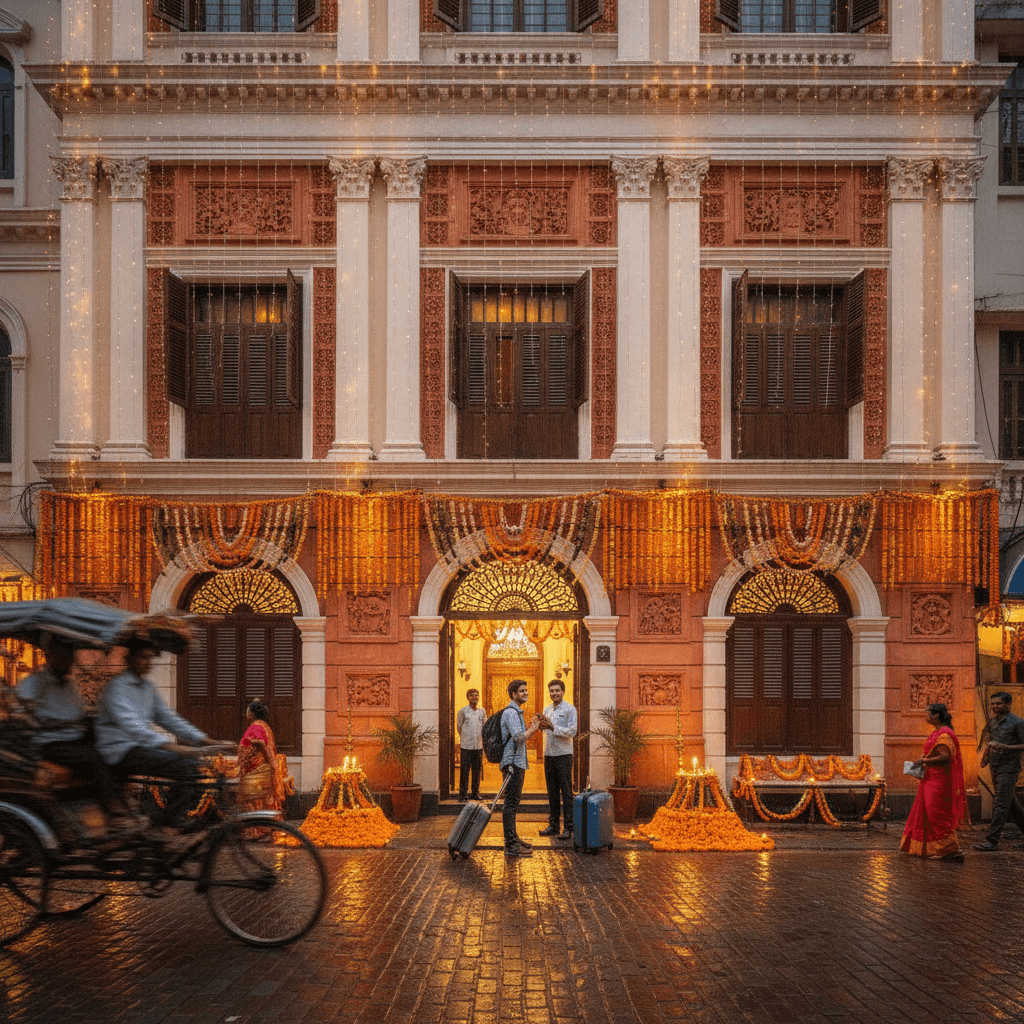
The draw here is the 'Bonedi Bari' pujas—the private pujas held in the courtyards of aristocratic, centuries-old mansions. Staying in North Kolkata feels like stepping back in time.
There's been a recent surge in beautifully restored heritage homestays and boutique bed-and-breakfasts in this part of the city. Booking one of these is incredibly special. Waking up in a 150-year-old courtyard house, eating luchi and aloor dum for breakfast, and walking out into the narrow lanes to see the neighborhood pujas is an experience you won't forget.
But let's be pragmatic for a second. North Kolkata during Puja is intensely claustrophobic. The lanes are already narrow. Once you add bamboo barricades, street food stalls, and millions of people, moving around becomes a full-contact sport. If you have mobility issues, or if you're traveling with small children who use a stroller, this area will be very difficult for you. I highly recommend staying here only if you're perfectly fine with being on your feet for hours in thick crowds.
Salt Lake & New Town: The Quiet Escape
Not everyone wants to breathe the festival 24/7. Sometimes you just want to see a few pandals, eat some good food, and then retreat to a quiet, air-conditioned room where you can actually hear yourself think.
If that sounds like you, look at Salt Lake or New Town. These are the planned, newer satellite townships of Kolkata. The roads are wide. The infrastructure is modern. This is where almost all the major luxury five-star chains are located.
Salt Lake has its own block pujas, which are massive and brilliantly organized. They draw huge crowds. But because the area is spaced out, it rarely feels as suffocating as the older parts of the city. New Town is even further out, closer to the airport.
The trade-off here is distance. You are physically far from the historic heartbeat of the city. If you stay in a luxury property in New Town, getting to the traditional pandals in South or North Kolkata is a mission. You'll spend a lot of time in traffic, negotiating with app-cab drivers who will inevitably cancel your rides. It's a great option for comfort. But you do lose a bit of the spontaneous, walking-the-streets magic.
A Few Realities About Booking Your Stay
People often search for hotels near Durga Puja pandals hoping for a perfectly convenient location. Here's the funny thing about Kolkata in October: almost every single building in the city is near a pandal. There are thousands of them. You literally cannot avoid them. What you should actually be looking for is a hotel near a Metro station.
I can't stress this enough. When you're dead tired at 2 AM after walking 15 kilometers, being able to hop on the metro—which runs all night during the main festival days—and get off a five-minute walk from your bed is priceless.
Another thing to keep in mind is food. Make sure your stay includes breakfast. Street food during Puja is incredible—you have to eat the egg rolls, the phuchka, the biryani. But mornings can be slow. Many local shops open late because the entire city was awake all night. Having coffee and breakfast sorted at your accommodation saves you a lot of morning frustration.
Finally, pack earplugs. Seriously. Even if you book a premium room in a nice neighborhood, sound travels. The drums, the music, the chatter of the crowds—it permeates the walls. It's the soundtrack of the city. But eventually, you might want to sleep.
Planning a trip to Kolkata for 2026 gives you the luxury of choice right now. Decide what kind of traveler you are first. If you want to dive headfirst into the culture and tradition, hunt for a heritage stay in the North. If you want convenience and food, lock down something around Park Street. And don't wait too long - booking well ahead is the only way to avoid picking from the scraps. Check the festival calendar too, so you know exactly which dates to lock in. In a city of joy, you definitely want a comfortable place to rest your feet.